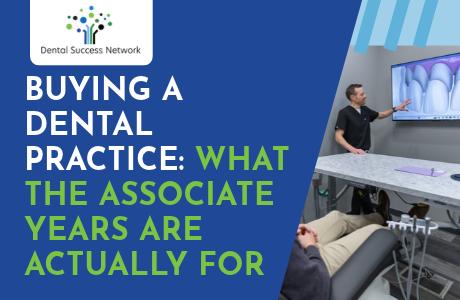
Most new grads think the associate phase is a waiting room, a place to park yourself until you’ve saved enough to buy in. It’s not. The associate years are where you either build the clinical and business foundation that makes ownership sustainable, or you skip the work and find out later what you missed. Buying a dental practice without that foundation is one of the more expensive lessons in dentistry.
What New Grads Are Actually Asking Right Now
Spend any time in forums where dental students and new grads talk honestly, and a few things become clear. Some are weighing AEGD programs, trying to get more reps with endo and surgical extractions before stepping into a production environment. Others are evaluating associate offers at established private practices, asking whether the patient flow is real and whether the owner will actually let them grow. And some, six years out, are still wrestling with procedures they never got comfortable with, wondering whether a skill gap will limit what they can earn or own someday.
These aren’t separate conversations. They’re the same conversation about readiness, and readiness is what determines whether buying a dental practice goes well or goes sideways.
The Skill Gap Problem Shows Up in the P&L
Here’s a scenario that plays out more than owners like to admit. An associate is hired into a practice that keeps treatment in-house, bread-and-butter restorative, crowns, endo, extractions. The owner expects the associate to handle a full mix of procedures. But the associate starts referring out surgical extractions, complicated endo, anything that makes them nervous. The owner absorbs the referral loss, patient flow gets disrupted, and the associate’s daily production number never reaches what the compensation structure assumed.
That’s not just a clinical problem. If you’re producing $800 a day when the practice needs $1,200 to make the associate model work, the owner feels it immediately in collections, and you feel it in your paycheck and your confidence. The DSN Associate Dentist Manual addresses this pattern directly, noting that associates who refer out cases the senior doctor could have handled are one of the most common sources of friction in the associate relationship.
An AEGD program at a program like the University of Florida or University of Maryland exists partly to close this gap before you enter a production environment. If you’re a D4 weighing an AEGD against jumping straight into an associate role, the honest question is whether you’re ready to produce at a pace that justifies the position.
What a Good Associate Position Actually Teaches You
A well-structured associate role at an established private practice does more than give you clinical reps. It shows you how a practice actually runs, and that education is worth more than most new grads realize until they’re on the other side of an acquisition.
Watch how the schedule is built. Notice whether the front desk is filling hygiene recare proactively or reacting to cancellations. Pay attention to how the treatment coordinator presents a $3,000 case versus a $300 one, and whether the close rate reflects skill or luck. If the practice uses Open Dental or Dentrix, spend time in the software beyond your own appointments, because understanding how production, collections, and adjustments flow through the system is foundational to running your own numbers someday.
The clinical skills matter, and so does this operational fluency. Owners who struggled in their first year of ownership often say the same thing: they understood dentistry, but they didn’t understand the business they’d just bought.
What You Need to Know Before You Buy
Buying a dental practice for $750,000, which is a reasonable price point for a solo general practice in a mid-size market, means you’re taking on debt that will likely require $8,000 to $12,000 a month in debt service depending on your loan terms. That number has to come from somewhere, and it comes from production minus overhead. If overhead is running at 60 to 62 percent and collections are consistent, the math can work. If you walk in and overhead is at 70 percent with a team that’s been there for fifteen years and never been managed toward any production goal, the math gets harder fast.
Before you sign anything, you need to understand a few things about the practice you’re buying.
First, look at the active patient count and the recare rate. A practice showing 1,200 active patients with a 70 percent recare rate is a different asset than one showing 900 active patients with a 55 percent rate, even if the revenue numbers look similar on the surface.
Second, pull the unscheduled treatment report and sort it by dollar value. A large unscheduled treatment balance can mean opportunity, or it can mean a patient base that doesn’t accept treatment, and you need to know which one it is before you close.
Third, understand the team. Talk to the office manager and the hygienist. Ask how long they’ve been there, how the schedule is typically managed, and what the current owner’s involvement looks like day to day. A practice where the owner is the culture will lose patients and team members when the owner leaves, and you’ll be the one managing that transition.
Understanding how the front office manages before you buy tells you a lot about what you’re actually purchasing.
The Leadership Gap Nobody Warns You About
Clinical readiness and financial due diligence are the parts of practice acquisition that get the most attention. The part that gets the least attention is leadership, and it’s often where new owners struggle most in year one.
When a hygienist isn’t hitting her daily production goal, or when your treatment coordinator is presenting every case over $2,000 without a consistent approach, those aren’t just process failures. They’re usually communication failures, and no amount of new software fixes that. You have to be able to have a direct conversation with a team member about expectations, set a measurable standard, and follow up on it without it becoming a confrontation. Most new owners weren’t taught this in dental school, and most associate positions don’t require it either.
DSN’s resources on dental office manager training and developing your leadership approach as address this directly, because the owners who figure out leadership early are the ones whose practices grow in year two and three instead of stalling.
What the Associate Years Should Leave You With
By the time you’re ready to buy, you should be able to answer a few questions without hesitating. What does a healthy collections-to-production ratio look like, and how would you know if yours was off? How would you handle a conversation with a front desk employee who’s been scheduling the hygiene column short for three months? What’s your plan for the first ninety days after acquisition, and who on the current team are you counting on to stay?
If those questions feel abstract right now, that’s useful information. It means the associate years aren’t done yet.
The Foundation That Makes Ownership Actually Work
Buying a dental practice is a financial decision, but whether it goes well is mostly an operational and leadership question. The owners who do well in year one didn’t just find a good deal on a practice. They spent their associate years paying attention to the business side of the offices they worked in, building the clinical range to keep production in-house, and learning enough about team management to lead people who didn’t choose them as a boss.
The one action worth taking this week, whether you’re a D4 evaluating your first associate offer or an associate two years in who’s starting to think about buying: sit down with the practice’s production and collections reports and ask the owner to walk you through them. Most owners will say yes. What you learn in that conversation will tell you more about practice ownership than any course.