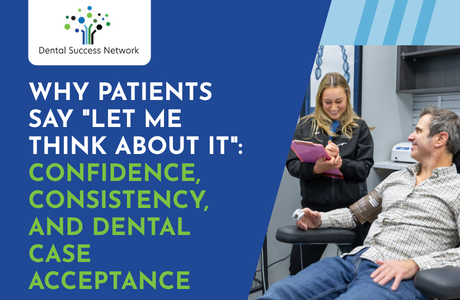
Every practice knows the moment. The exam is done, the treatment plan is presented, and the patient says, “Let me think about it.” Then they leave, and the plan sits in the system unscheduled.
Most teams blame the economy, the patient’s insurance, or the patient’s budget. Sometimes those are real factors. More often than practices like to admit, the real reason a patient walks is that they never felt sure. As DSN has covered before, patients commit when they feel seen, heard, and confident in the doctor in front of them.
Dental case acceptance is rarely lost on the evidence. It is lost on the uncertainty.
Patients Decline Uncertainty, Not Evidence
A patient cannot evaluate a radiograph the way a dentist can. They cannot judge pocket depths or interpret bone loss. What they can judge, very accurately, is whether the people in the room seem sure of what they are saying.
When a recommendation sounds hesitant, the patient does not hear clinical nuance. They hear risk. And a patient who senses risk does the natural thing: they wait.
That means the treatment presentation is not only a transfer of clinical information. It is a test of confidence, and patients grade it in real time.
What Uncertainty Sounds Like in the Operatory
Uncertainty usually shows up in small words. “I’m pretty sure this is the right approach.” “We should probably look at a crown.” “This might be worth doing at some point.”
DSN co-founder Dr. Addison Killeen tells a story on himself here. His wife, who also fills in as his hygienist, calls him out every time he says probably, maybe, or possibly in front of a patient. She is right to. Each of those words chips away at the trust the patient needs to say yes.
Think about an umpire who calls a strike, then a ball, then changes his mind. Nobody can play a game officiated that way. The umpire’s job is not to be right about every pitch in some cosmic sense. It is to make the call clearly and stand behind it. Patients need the same thing from their dental team.
Humble in the Diagnosis, Confident in the Recommendation
None of this means a dentist should fake certainty or oversell. The balance is precise: humble enough to know there is not an answer for everything, and confident enough to fully commit to the best answer available.
In practice, that looks like two distinct phases. The team gathers information humbly. They ask questions, listen, review the findings, and consider the options. Then the doctor decides with authority and presents one clear recommendation.
That confidence is not something announced. A doctor who says “trust me” has usually already lost the room. Confidence is something the patient experiences across the whole visit, from the hygiene chair to the checkout desk.
Mixed Messages Are the Real Case Acceptance Killer
Here is where many practices lose cases without realizing it. The hygienist describes a condition one way. The assistant uses different words. The doctor explains it a third way. The treatment coordinator adds a fourth version when discussing cost.
Each team member may be clinically accurate. To the patient, it sounds like five different opinions. And uncertainty makes it very hard to say yes to a four-figure treatment plan.
Compare that to a visit where the hygienist plainly says, “This isn’t inflammation, it’s an active infection. Here’s what happens if we leave it.” Then the doctor walks in and confirms the same message in the same words. The patient senses the consistency, and consistency reads as truth. DSN’s guide to getting the yes from patients makes a similar point about choosing positive, specific language over vague or limiting phrases.
This is why high-performing practices standardize their language and coach it. Standardized does not mean robotic. It means the team agrees on what they are saying before the patient ever sits down.
Confidence Is Competence Practiced Into Reflex
Confidence does not come from a pep talk. It comes from competence, practiced until it becomes reflex.
A hygienist speaks with confidence because the protocol is written down, the team is calibrated, and she has said those words a hundred times. Nobody talks themselves into that kind of confidence. It is the same principle behind dental practice fundamentals that never change: repeat the right habits until competence naturally inspires trust.
That repetition also requires leadership. Team members cannot deliver a message consistently if no one has defined it for them. As DSN has written about delegation, teams cannot read the doctor’s mind, and clear expectations are what make consistent execution possible. Once the language is defined, someone has to keep reinforcing it. Dr. Ben Kacos describes this role as becoming the practice’s “Chief Repeating Officer”, harping on the things that matter until they stick.
Where to Start This Week
The fastest way to improve dental case acceptance is not to overhaul every presentation at once. Start with one.
- Pick one common procedure. Choose something the practice presents often, such as periodontal therapy, a crown on a cracked tooth, or replacing a failing restoration.
- Write two or three sentences. Define exactly how the team will describe the problem and the solution. Keep it plain enough that a patient could repeat it at home.
- Get everyone using the same words. Hygiene, assistants, the doctor, and the treatment coordinator should all describe that procedure the same way.
- Practice until it is reflex. Run it in morning huddle. Role-play it. Listen for drift and correct it early.
Once one procedure is consistent, move to the next. Over time, the whole practice starts to sound like one confident voice.
The Confident Conversation Gets Patients Healthy
It is easy to treat confidence as a sales skill. It is not. Patients who leave with “let me think about it” often leave with untreated disease. The confident, consistent conversation is the one that actually gets the patient healthy.
Building that kind of calibrated team is hard to do alone while also seeing patients and running a business. If the practice is ready for outside perspective on case presentation, team communication, and the systems that support them, Dental Success Network offers coaching and a community of dentists who are working through the same challenges every day.